I didn’t have trouble recognizing this beautiful bird, who wouldn’t with his majestic black robe. His name is perfectly suited for its unique dark plumage, as the name phainopepla originated from the Greek phain peplos or “shining robe.” In bright sunlight, these birds do shine, and the male’s glossy plumage is unmistakable, as shown in the above image. The Phainopela has white wing-tips that can be seen in flight.
In the summer, the local Phainopeplas migrate up the canyon to Mt. Lemmon, where it’s cooler with a lot in insects, returning to the lower canyon in the winter when insects are scarce to feed on mistletoe berries. As “A Naturalist’s Guide To Sabino Canyon” point out, “Sticky mistletoe seeds pass through digestive system sticking to branches where they perch, spreading mistletoe from tree to tree.” Welcome back, “black dude!”
SCVN Class of 2011 Taking Notes As Bill Kaufman Leads Them On A Nature Walk In Sabino Canyon — Image by kenne
During our Sabino Canyon Volunteer Naturalists (SCVN) training this fall, in addition to taking many photos, I took a few video clips that I have edited into the following videos.
Naturalist, Gwen Swanson, Demonstrates “Panning” to Students — Image by kenne
The Sabino Canyon Volunteer Naturalists (SCVN) training includes many topics important to Sabino Canyon and the Santa Catalina Mountains in southern Arizona. One of the topics is the study of Earth’s history. Over time, the region has undergone geological changes that have made the canyon what it is today.
Yesterday, I observed fifth-graders participating in the SCVN activity, “Strike It Rich,” conducted by naturalist, Gwen Swanson. The creekside activity allows children to learn about difference between rocks and minerals by panning for garnets and magnetite in the sand, and the importance of water in forming the canyon.
One of the things unique about Sabino Canyon are its banded cliffs. Students learn that these beautiful formations are composed of a hard metamorphic rock called “gneiss,” which formed 1.5 billion years ago. In the Strike It Rich kit, students see example of minerals and gneiss. After the panning activity, the naturalist leads the students on a nature walk where they see the geology of the canyon, pointing out examples of gneiss.
kenne
Gwen Swanson Using a Magnet to Show That Magnetite in the Sand Along Sabino creek — Image by kenne
Gneiss Boulders Along Sabino Creek — Image taken in mid-September by kenne
Gwen Swanson Leading A Nature Walk Through The Riparian Area of Sabino Canyon — Image by kenne
. . . this was Sabino Creek, October 27th. There was a nice flow after late monsoon rains in September, but as noted in this morning’s Arizona Daily Star, “A brief autumn dry-up of the stream is not uncommon after monsoon rains end. But this year’s rains were sketchy in the canyon, and the forecast shows no promise of moisture to turn the flow on again anytime soon.” (Click here to read more.)
The creek has been without a flow since mid-October, making it a little difficult for the Sabino Canyon Volunteer Naturalists (SCVN) to conduct one of their elementary school children activities, “Creek Critters,” this past week.
However, a few ponds of water remain, so the schedule of activities along the creek continued.
There was plenty of water for the kids to have fun learning about the unique aquatic and riparian habitats in a desert environment. Few things can out do a day in Sabino Canyon, water flowing or not!
I like going to Sabino Canyon — I like going to Sabino Canyon, a place to be with nature. I like the people there, sharing feelings with nature. I like being able to see the beauty of nature. I like going to Sabino Canyon — I like being able to reflect on nature’s art. I like close-up encounters with all things natural. I like capturing the moment and drawing inspiration from nature. I like going to Sabino Canyon — I like learning new ways
to connect with nature. I like getting to know myself through the connections. I like being surprised by the wonders of nature. I like going to Sabino Canyon — I like the feeling of being alive by walking with nature. I like knowing that forever is the life of nature. I like knowing that all that is is nature. I like going to Sabino Canyon.
Although blog entries haven’t shown it lately, I have spent a lot of time in Sabino Canyon observing and learning a much a I can in training to become a Sabino Canyon Volunteer Naturalist (SCVN). One of the ways I learn is to take images, identify the plant or animal and post it on the blog and/or in my Flickr account. The conditions in the desert are now very dry, but it hasn’t stop the foldwing from doing its thing. It blossoms in the Spring, Summer (after the summer monsoon rains) and early Fall. As you can see, the bees are taking advantage of the blossoms still being around. Click here to learn more about this plant at fireflyforest.com.
Panoramic view with Sabino Canyon on the left, Blackett’s Ridge end of trail in the middle, Bear Canyon on the right. Image by kenne
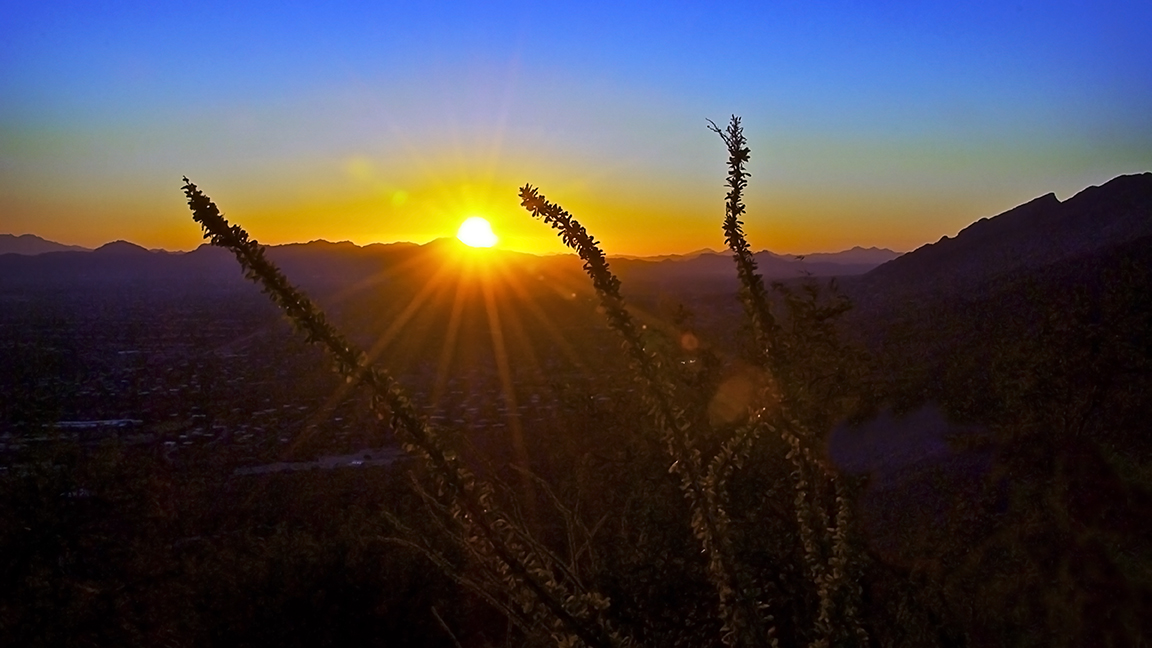
“What a great idea,” I thought when one of the Sabino Canyon Volunteer Naturalists (SCVN) asked if any of the trainees were interested in hiking Blackett’s Ridge late Tuesday afternoon to see the sunset as the full moon begins its rise. Not only would there be great photo opts, but there would also be the experience of hiking down the ridge in the light of the full moon. “Cool!”
On the short drive home after the SCVN training, I thought more about hiking in the light of a full moon. However, I wasn’t sure about the time of the hike nor the name of the naturalist who made the announcement. However, I did recall hearing something about “3:30 pm.”
So, at 3:30 pm the next day, I was at the Sabino Canyon Center. After waiting for a few minutes and not seeing anyone I recognized, I decided to head out — I may have missed the “moonlight” hikers, or if they were leaving later, I could wait for them at the trail end.
Stopping several times along the way to take photos and video, I still completed the upward leg in one hour and thirty-seven minutes, which was faster than when hiking with others, making my arrival sooner than expected. Besides being a warmer than average Tucson day in October, the hiking conditions were excellent in a cloudless sky. Even so, I didn’t pass anyone going up or coming down as I hiked the ridge.
Once reaching the end of the trail, it was clear I was all alone. Still, I had hoped others would be coming up soon, having already concluded I had left about thirty minutes too early — so I waited.
After being at the trail end for thirty minutes, I decided to start the hike down the ridge; even though I would not get sunset photos at the trail’s end, I could still get them on the way down.
I was only a few minutes down the trail when I saw the naturalist who had suggested the moonlight hike. (I now know his name is Phil.) He was alone and on his cellphone — we shared howdy’s as I passed him, continuing down the ridge. I was surprised that no one was with him, even more so having now experienced the moonlight hike — maybe next time!
After stopping to get sunset and full moon shots, I continued down the ridge, now by moonlight.
I always try to be cautious when hiking, especially when alone. The only movement around me was my shadow from the moonlight.
Hiking in the light of the moon is a real adventure — I loved it. However, I must admit that hiking all along at night, and knowing that mountain lions are generally nocturnal, was a little disconcerting. I could almost feel eyes watching me!
About an hour from the center, I called Joy to tell her I should be home a little after seven. Having previously told her I would be hiking with others, I told her I had hiked Blackett’s Ridge alone. Then, of course, I got a real ass-chewing — better on the phone than later.
Wait, there is more to this story.
The following day I was in Sabino Canyon observing one of the SCVN classes for elementary school kids in the riparian area. After the class, I began the walk back to the center parking lot with some fellow SCVN trainees. As we walked, I shared my Blackett’s Ridge moonlight story. Then, of course, there were questions about the moonlight hike’s difficulty, to which I said my only concern was for mountains lions.
“Mountain lions,” said one of my fellow trainees, “I have a story for you about mountains and Blackett’s Ridge!”
It so happens that his wife is a guide at Canyon Ranch Resort. A while back, she was leading a group on Blackett’s Ridge when they came upon a mother mountain lion with two cubs feeding on a recent kill. They promptly stopped and slowly moved back down the trail. As they proceeded down the ridge, they met a young woman and told her about the lion and cubs near the trail, suggesting she turn around. However, she wanted to see the lion and her cubs, so they warned her, whatever she did, not to run from the mountain lion.
The young woman proceeded up the trail — moments later, she was screaming and running back down the trail with the mountain lion coming after her. Obviously, she had not followed their advice about running from the mountain lion. So the group began making all kinds of noise and waving jackets to cause the lion to stop, which she did. After slowing her chase, the mountain lion watched for a moment, then returned to her cubs.
There was a part of me thinking, “I didn’t need to hear that story!”