The “Future Starts Slowly” — What a title. I love it!
I recently wrote in a June 23, 2011 blog posting, “We live in a world in which our thinking is ‘here and now,’ focusing on how to make things faster and cheaper. The now needs to involve longterm thinking, focusing on slower and better.” The result is quality, which describes The Kills latest single, “The Future Starts Slow.”
“Dreamy and feverish, hooky and repetitive, obsessive and claustrophobic,” are the words used to describe The Kills new album on the 2011 Lollapalooza website. Whatever the words, the duo is a group I would like to see live, instead, I will settle for this excellent video.
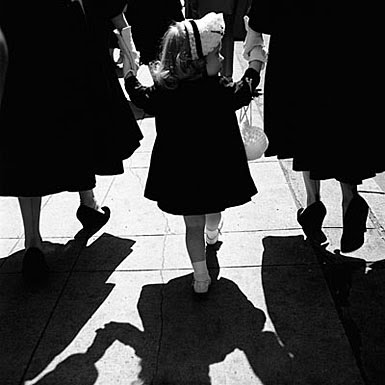
A box of film negatives purchased at a Chicago auction in 2007 by John Maloof, a young real estate agent, may turn out to be the discovery of the Emily Dickinson of Photography. To date, little is known about this private, “keep your distance” excentric. Yet, as the photography world becomes aware of her captivating photos, she quickly becomes a much-admired photographer after her death two years ago. Starting the past Friday, the Chicago Cultural Center has a one-woman show, “Finding Vivian Maier: Chicago Street Photographer.” Only time will tell if Vivian Maier will reach the statue of an Emily Dickinson of Photography, but interest she has already created can’t help but make one wonder.
Here are some links where you can learn more, see some of her work, and judge for yourself:
Admittedly, I may be biased, having grown up in the Chicago area during the ’50s and ’60s, which is the time frame of many of the current prints. The images offer a much appreciated photographic history of this great city in the mid-twentieth century.
Robert Shetterly has painted a collection of “Americans Who Tell The Truth.“ I just learned about Robert because one of his portraits is that of Studs Terkel. Each painting includes a quote. The Studs quote is:
“Perhaps it is this specter that most haunts working men and women: the planned obsolescence of people that is of a piece with the planned obsolescence of the things they make. Or sell. It is perhaps this fear of no longer being needed in a world of needless things that most clearly spells out the unnaturalness, the surreality of much that is called work today.”
In his “Artist’s Statement,” Shetterly writes: De Toqueville said, “America is great because it is good. When it ceases to be good, it will cease to be great.” A democracy, whose leaders and media do not try to tell the people the truth, is a democracy in name only. If the consent of voters is gained through fear and lies, America is neither good nor great. Nor is it America.” He goes on to say,
“The more I’ve learned about American history — past and present — the more people I’ve discovered whom I want to honor in this way. The paintings will not be for sale. They will stay together as a group. The courage of these individuals needs to remain a part of a great tradition, a united effort in respect for the truth. Eventually, I will give the portraits to one museum or library on the condition that they continue to be shown. These people form the well from which we must draw our future.”

 Jonn Del Toro Richardson & Rich DelGrosso at Ken & Mary’s Blues Project, October, 2011 — Image by kenne




Robert Shetterly has painted a collection of “Americans Who Tell The Truth.“ I just learned about Robert because one of his portraits is that of Studs Terkel. Each painting includes a quote. The Studs quote is:
“Perhaps it is this specter that most haunts working men and women: the planned obsolescence of people that is of a piece with the planned obsolescence of the things they make. Or sell. It is perhaps this fear of no longer being needed in a world of needless things that most clearly spells out the unnaturalness, the surreality of much that is called work today.”
In his “Artist’s Statement,” Shetterly writes: De Toqueville said, “America is great because it is good. When it ceases to be good, it will cease to be great.” A democracy, whose leaders and media do not try to tell the people the truth, is a democracy in name only. If the consent of voters is gained through fear and lies, America is neither good nor great. Nor is it America.” He goes on to say,
“The more I’ve learned about American history — past and present — the more people I’ve discovered whom I want to honor in this way. The paintings will not be for sale. They will stay together as a group. The courage of these individuals needs to remain a part of a great tradition, a united effort in respect for the truth. Eventually, I will give the portraits to one museum or library on the condition that they continue to be shown. These people form the well from which we must draw our future.”
Learn more about this remarkable collection at:
http://www.americanswhotellthetruth.org/
kenne
Share this:
Like this: