“It’s not just that the people at the top are getting richer. Actually, they’re gaining, and everybody else is decreasing… And right now, we are worse than Old Europe.”

“It’s not just that the people at the top are getting richer. Actually, they’re gaining, and everybody else is decreasing… And right now, we are worse than Old Europe.”

 Source: Google.com
Walt Kelly’s message, “We have met the enemy and he is us,” which he effectively communicated through Pogo, is a firm but gentle approach at telling the truth. Yet, we are still living in an economic, environmental and moral “garbage dump” forty years after Porky and Pogo first looked over their trash filled swamp. Where are the all-wise Pogos’ of the world when we need them?
“YEP, SON, WE HAVE MET THE ENEMY AND HE IS US.”
kenne

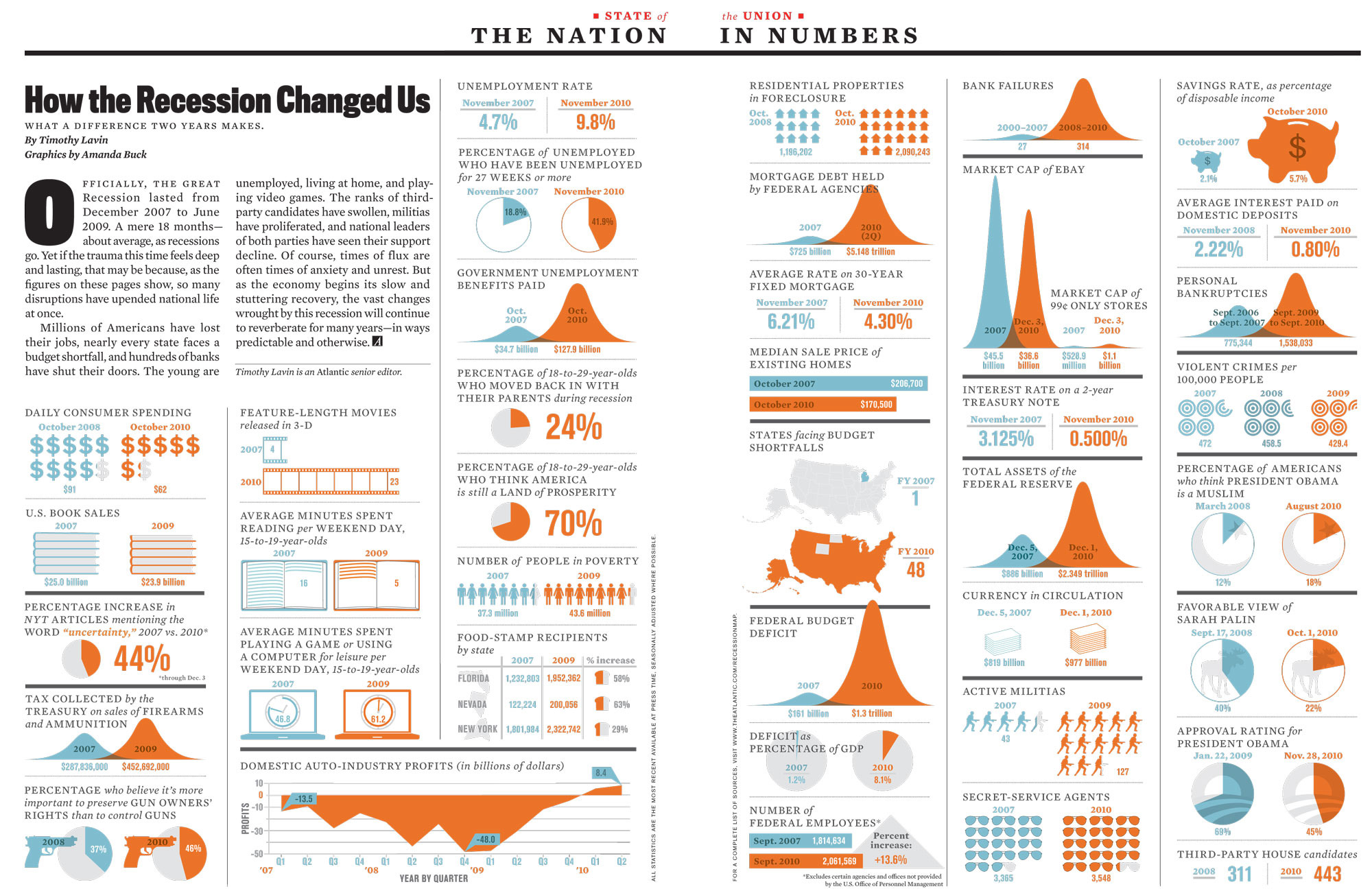 Source: The Atlantic (Click On Image To Enlarge.)

Most of us realize that a virtual world is not the real world. Yet, the banking world, which sees itself as a collegial group that is smarter than the rest of the business world, apparently ignored the many uncontrollable constraints in the real world that are nonexistent in the virtual world of the mathematical models of the “quants.” Quants are at the helm of Power Driven Trading using brain-twisting math and super-powered computers to create virtual financial products minus real world constraints and a willingness to see responsibility only as a one-way street.
Much has been written about the quants impact on Wall Street, but most of us may not have the time or motivation to take on the topic. However, this video, Quants: The Alchemists of Wall Street, on YouTube. I would caution the viewer to keep in mind that this informative video is a helpful perspective, but not to conclude that quants caused the financial crisis.
kenne

Much has now been written and well documented about the great recession of 2008-09, from Paul Krugman, “How Did Economists Get It So Wrong?” to Matt Taibbi’s article “Inside the great American bubble machine.” What has become clear to any reader is that Goldman Sachs engineered the market manipulation that brought about the recent credit crisis. Therefore, it was not surprising to see Goldman Sachs posting the richest quarterly profit in its 140-year history between April and June 2009 – at the height of the economic crisis.
Just a few days ago, the following video appeared on YouTube that is a visualization of Matt Taibbi’s article in Rolling Stone magazine. It’s time to start electing people to Congress that will stop filling their own pockets while allowing big banks to make record profits at the expense of hard working Americans.
kenne

The book club to which I belong, “The Society of the 5th Cave,” is made up of members, all-be-it old educated professionals, males who pride themselves in being specialists in many areas, but with the age-accepting reality of being skilled in few. Mostly politically right of center seeking to help me see the light, convinced that those with opposing views are also conducting their act of ministry. Wrong, oh truth sayers! Although I may debate a position, I don’t want everyone to agree with me, and I want each person to think. That’s why I selected Life Inc. How The World Became A Corporation And How To Take It Back by Douglas Rushkoff for the September reading. (Click here to see Rushkoff on Colbert Nation.) It is a book that can help people better understand today’s economic and financial issues, which Rushkoff feels are not a problem of reality or nature but a design problem. Are corporations evil? No! Neither are the people who work within their controlling environments. However, there is a convincing case to be made for redesigning a poorly designed invention of our culture by identifying non-market ways of developing gift-exchange institutions.
We humanize the corporation, so much so that many who may take a road-trip vacation tend to seek out a McDonald’s in which to eat rather than going to a local establishment. If this is your comfort level, you don’t want to travel between the tiny Dakotan hamlets of Meadow and Glad Valley. According to Stephen Von Worley on the Weather Sealed blog, this is where you will be hurtin’ if you suffer a Big Mac Attack.
Most of us are products of the corporate mentality and lifestyle. I have worked hard to get to an age where I’ve collected enough assets to make money by having money. Even though recognizing that my life and my fortune are controlled and manipulated by our corporate state, I’m now working hard to become part of the gift economy – doing something for nothing and stop behaving like corporations who “… express charitable and community impulses from afar.” A gift economy is a society where goods and services are exchanged without any explicit agreement for immediate or future rewards.
“By donating to charities in the same manner as our corporate equivalents, we succumb to the proxy system that dissocializes in the first place.” Instead, we can start reclaiming what has been lost by accepting that small is the new big and that through a highly networked world, we can begin making local impacts that it spread. Rushkoff gives many examples of sustainable local efforts that trickle up in profound ways. The more we network doing something for nothing, the more one voluntary act encourages another. Giving is a social phenomenon that should be a fundamental life skill. As Walt Whitman wrote in Carol of Words: “The gift is to the giver, and comes back most to him – it cannot fail.”
Rushkroff’s belief that commerce has been separated from the people doing the stuff and his reference to the gift economy brought to mind Lewis Hyde’s excellent book, The Gift – Creativity and the Artist in the Modern World. Written over twenty-seven years ago, his insight and guidance are even more apropos given today’s economic and financial challenges. Here is how Hyde summarizes The Gift:
“The main assumption of the book is that certain spheres of life, which we care about, are not well organized by the marketplace. That includes artistic practice, which is what the book is mostly about, but also pure science, spiritual life, healing, and teaching….This book is about the alternative economy of artistic practice. For most artists, the actual working life of art does not fit well into a market economy, and this book explains why and builds on the alternative, which is to imagine the commerce of art to be well described by gift exchange.”
In his chapter titled “The Labor of Gratitude,” Hyde uses the folk tale “The Shoemaker and the Elves,” a tale of a gifted person, as a model of the labor of gratitude. In the tale, the shoemaker makes his first pair of shoes to dress the elves, which is the last act in his labor of gratitude. When Hyde speaks of labor, he refers to human endeavors such as “writing a poem, raising a child, developing a new calculus, resolving a neurosis, invention in all forms,” as distinguished from “work,” that we do by the hour. Labor has its own schedule. Things are accomplished, but often we feel as if wasn’t us who did them. This is always a bit mysterious. It is the mystery Federico Garcia Lorca was referring to when he wrote at the bottom of one of his drawings he did in Buenos Aires, “Only mystery enables us to live.” Invoking the mystery is to invoke the Duende.
Suppose we value the mystery and the categories of human enterprise that invoke the mystery, such as family life, spiritual life, public service, pure science, and artistic practice. In that case, none of which operates well in the corporate marketplace, so we must find non-corporate ways to organize and support them.
We humanize the corporation, so much so that for many who may take a road-trip vacation, tend to seek out a McDonald’s in which to eat, rather than going to a local establish. If this is your comfort level, then you don’t want to be traveling between the tiny Dakotan hamlets of Meadow and Glad Valley. This is where, according to Stephen Von Worley on the Weather Sealed blog, you will be hurtin’ is you suffer a Big Mac Attack.
Most of us are products of the corporate mentally and lifestyle. I have worked hard to get to an age where I’ve collected enough assets to make money by having money. Even though recognizing that my live and my fortune is controlled and manipulated by our corporate state, I’m now working hard becoming part of the gift economy – doing something for nothing and stop behaving like corporations who “… express charitable and community impulses from afar.” A gift economy is a society where the exchange of goods and services are given without any explicit agreement for immediate or future rewards.
“By donating to charities in the same manner as our corporate equivalents, we succumb to the proxy system that dissocializes in the first place.” Instead, we can start reclaiming what has been lost, by accepting that small is the new big and that through a highly networked world we can begin making local impacts that it spreads. Rushkoff gives many examples of local sustainable efforts that effectively trickle up in profound ways. The more we network doing something for nothing, the more one voluntary act encourages another. The act of giving is a social phenomenon that should be a fundamental life skill. As Walt Whitman wrote in Carol of Words: “The gift is to the giver, and comes back most to him – it cannot fail.”
Rushkroff’s belief that commerce has been separated from the people who are doing the stuff  and his reference to the gift economy brought to mind Lewis Hyde’s wonderful book, The Gift – Creativity and the Artist in the Modern World. Written over twenty-seven years ago, his insight and guidance is even more apropos given today’s economic and financial challenges. Here is how Hyde summarizes The Gift:
“The main assumption of the book is that certain spheres of life, which we care about, are not well organized by the marketplace. That includes artistic practice, which is what the book is mostly about, but also pure science, spiritual life, healing and teaching….This book is about the alternative economy of artistic practice. For most artists, the actual working life of art does not fit well into a market economy, and this book explains why and builds out on the alternative, which is to imagine the commerce of art to be well described by gift exchange.”
In his chapter titled “The Labor of Gratitude,” Hyde uses the folk tale, “The Shoemaker and the Elves,” a tale of a gifted person, as a model of the labor of gratitude. In the tale, the shoemaker makes his first pair of shoes in order to dress the elves, which is the last act in his labor of gratitude. When Hyde speaks of labor, he is referring to human endeavor such as “writing a poem, raising a child, developing a new calculus, resolving a neurosis, invention in all forms,” as distinguished from “work,” that we do by the hour. Labor has it’s own schedule. Things are accomplished, but often we as if wasn’t us who did them. This is always a bit mysterious. It is the mystery Federico Garcia Lorca was referring to when he wrote at the bottom of one of his drawings he did in Buenos Aires, “Only mystery enables us to live.” Invoking the mystery is to invoke the duende.
If we value the mystery and the categories of human enterprise that invoke the mystery, such as family life, spiritual life, public service, pure science and artistic practice, none of which operates well in the corporate market place, then it is necessary that we find non-corporate ways to organize and support them.
kenne

 CartoonColdbeacon
. . . other than using yesterday’s lessons as a place to begin.
 Two years ago, while on a two-week road trip from Houston to Vegas, I begin to digest some of what I had been reading on the economy and the financial markets, which was beginning to give me reason to be concerned for our financial future. Not being a student of either, I felt a need to become more informed and directly involved in the management of our assets, which meant I had a lot to learn. To do so, I needed someone (advisory) that would not only be more client-oriented, but also be a teacher – someone who could be my mentor. I found that person in Bob McNeily. Since that time we have seen the Dow go from over 14,000 to below 7,000 — a severe drop by any definition, while managing a 28% demise of our personal financial portfolio (I’m pleased to note that this loss has been completely erased.), and the government becoming the bank of last resort.
The economy did finally fall into recession by the end of 2007. Since then real GDP has fallen by almost 4% and the unemployment rate has gone up by almost 5%. Now we are told the recession is over, but the scares on the economy remain and many questions still unanswered.
How did the experts get it so wrong?
Can they learn from their mistakes?
Will politics thwart any meaningful reform?
Are banks, even now, re-creating the conditions that lead to a near-financial collapse?
The answers to these and many others will depend on whose history you will be reading tomorrow. However, some answers can come by fast-forwarding to the past and reading what a little known economist, who studied and wrote on capitalism and why it fails, had to say. Hyman Minsky, a student of both the great depression and capitalism, predicted decades ago, the recent global financial meltdown, so accurate were his predictions that current pundits are referring to the meltdown as the “Minsky meltdown.”
“Instability,” Minsky wrote, “is an inherent and inescapable flaw of capitalism.” You can read more about Minsky’s vision in the September 13, 2009 Boston Globe article by Stephen Mihm, “Why capitalism fails – The man who saw the meltdown coming had another troubling insight: it will happen again.” Mihm writes, “Minsky did not share his profession’s quaint belief that everything could be reduced to a tidy model, or a pat theory. His was a kind of existential economics: capitalism, like life itself, is difficult, even tragic. ‘There is no simple answer to the problems of our capitalism,’ wrote Minsky. ‘There is no solution that can be transformed into a catchy phrase and carried on banners.’”
Another excellent article, “How Did Economists Get It So Wrong, “ by Paul Krugman, September 6, 2009 in “The New York Times Magazine.”
kenne

 The Texas economy is the 15th in the world based on GDP figures, let in this time of instant change in issues of a large dynamic state, the legislature only meets from January through May every two years. Yesterday, the current biannual session ended with many very needed bills now dead, unless the governor calls a special session. Setting up budgets every two years make no sense at all. It’s a part of the original Texas Constitution, which is seem. as something carved in stone, not something that evolves with the needs of today’s people, rather than those of 1875. In 1875, the constitution represented the desires of farmers, which were interested in limiting the powers of government by making the constitution very complex and disorganized, thereby an impedance to decisive action. For a state as large as Texas, with one of the largest economies on the globe, meeting 140 days every two years makes it impossible to keep up with today’s economic challenges.
kenne

. . .or just a pipe-dream? You decide!
kenne

Thinking out loud today, “what is bad is good,” and “what is good is bad” — good reports out today and the market goes down. Maybe to understand this game, or to be able to play it successfully, you have to be a Pinball Wizard —
“That deaf, dumb and blind kid
Sure plays a mean pinball.”
kenne

No wonder newspapers are going out of business! Just remember, as with newspapers, “don’t believe everything you read . . .!”
http://www.ritholtz.com/blog/2009/04/financial-pugilism-and-offbeat-analysis/
Be smart!
kenne

 Old Alamo Bank Lobby, San Antonio, Texas — Image by kenne
— kenne

 On the one hand, we need to stop using credit cards and save, while on the other hand the American economy is driven by the American consumer. What’s a real American to do? Save or spend? Spend or save? How about this: Save, then spend! Then we will have things in the right order.
kenne
Cartoon source: http://www.Wulffmorgenthaler.com Daily Strip, April 15, 2009

Songwriters and poets know how to ask the real questions!
kenne


Robert Reich helps you connect the dots — get the big picture!
kenne
Share this:
Like this: